Skip to content
goTool Español

goTool › Security

Security

A security analyst on duty on every server.

goTool is installed on each Linux server and looks at what an analyst would look at if they could watch all the time: the websites, the logins, the containers, the databases and the machine itself. Anything serious reaches you right away, before you hear it from a customer.

Ask us for a demoStep-by-step fixes

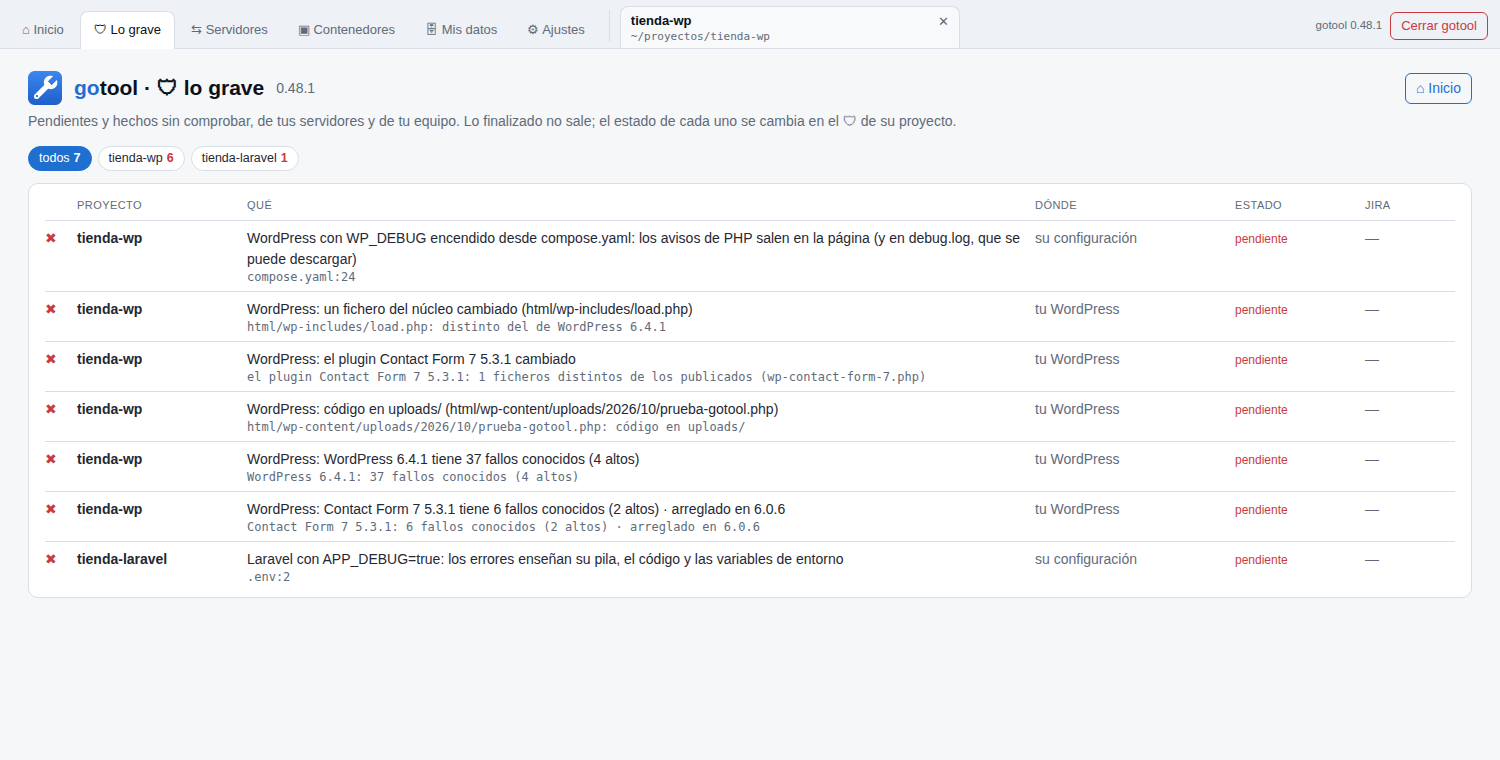
goTool's 🛡 Serious tab: what's on your servers and on your computer, from all your projects.

Has someone got in? Are they about to?

The two questions goTool asks about every website, every container and every machine. Each answer comes with where it comes from and what to do.

Compromised: someone is already in

  • WordPress and Moodle compared with the published releases: a different file or extra code in the core, the plugins or the themes.
  • PHP in the uploads folder, backdoors and webshells, new administrators and cron jobs that change passwords.
  • New code inside a container, or a reverse shell, a miner or a program running from /tmp.
  • On the machine: new accounts, keys, startup items or ports, system programs that were swapped and SSH logins out of the ordinary.

Exposed: only a matter of time

  • Known vulnerabilities in each app, plugin, library and container image, with the fixed version; versions out of support.
  • Files visible from outside: .env, .git, .sql backups, old wp-config copies, debug panels.
  • Containers running as root or --privileged, secrets in an image's history, databases with too many privileges.
  • Ports open that shouldn't be, old TLS, certificates about to expire and forgotten subdomains.

What it watches, on its own, non-stop

Everything it finds becomes a ticket with its severity and its number, the same one that reaches Telegram. The first time it takes a baseline snapshot; from then on, anything new is an alert.

WhatHow oftenWhat it checks
Websites5 minThat they answer, certificates about to expire, exposed files, headers, blocklists and forgotten subdomains
Apache and nginxcontinuousTheir sites (disabled ones too), their security and whether the service goes down
Applicationscontinuous and dailyWordPress, Moodle, Drupal, Joomla, Magento, PrestaShop, Laravel, Symfony, Node, Python and Go: version, support, vulnerable libraries, new code, webshells
Attacks on websitescontinuousBrute force, SQL injection (sqlmap and data dumps included), panel probing; by IP and with its country
LoginscontinuousSSH brute force; per account, the first login, a new IP or odd hours; logins deleted from the log
The machine15 minAccounts, sudo, keys, ports, firewall, what starts on its own, odd processes, rootkits, updates and paths to root
Integrity12 hSystem programs that don't match their package: sshd, ls, ps, PAM…
Containerscontinuous and dailyStopped or restarting, known vulnerabilities in each image, secrets in their history and anything odd inside
Databases15 minMySQL/MariaDB, PostgreSQL and MongoDB: users, excess privileges, triggers that change passwords, and who changes accounts in Moodle and WordPress
The networkliveWho each process calls, blocklisted IPs, trojan ports, unusual data uploads and someone impersonating the router (ARP)
From outsideevery roundThe other servers test this one's ports: FTP, Telnet, SMB, RDP, databases, Docker, Redis, SNMP
EmaildailySPF, DKIM and DMARC, look-alike domains, passwords stolen by infostealers and hidden forwarding rules
Logs15 minSigma rules (attempts to become root, defences switched off) and your apps' errors, grouped

Where intruders hide to stay

Whoever gets in wants to stay even if you change the passwords, so they leave something that runs on its own. goTool watches all those places and alerts you as soon as one appears or changes.

The usual places

Every user's cron, systemd services and timers, rc.local and ld.so.preload.

The forgotten ones

Scripts run at every SSH login, apt hooks, udev, at, PAM, what bash loads (a fake sudo) and network scripts.

Serious right away

Anything running from /tmp, anything that downloads and runs (curl … | sh) and a cron that changes passwords or touches another user's website.

The real case behind this: they got in through a WordPress plugin and left a cron that changed the passwords of a Moodle on the same server every few minutes. goTool alerts you right away, says which website it touches and looks for how they got in.

It alerts you, not a dashboard

Telegram and email

Serious issues right away, with their colour dot, their ticket and each IP's country. What breaks again and what fixes itself. And a daily summary: if it doesn't arrive, something is wrong with that server.

Read more →

Servers in a ring

Each server watches the next one. If one goes down or stops answering, its neighbour tells you. Without opening ports to the internet.

Each issue with its status

Pending, done or closed. Whoever fixes it says «done» and goTool checks on the next round; if it's still there, it goes back to pending. Jira too.

With its fix

Each serious issue comes with its steps, how to check it and what to do if that won't work, with your project's names.

Read more →

The tampered invoice

Can this email be trusted? Spoofed sender, look-alike domain, a changed IBAN, urgency. And whether your domain lets others send in your name.

My network

From your computer, the devices in your office: what's connected, what's open and what has newly appeared.

And on your computer, before you push

Almost everyone builds their Docker with their WordPress, tests it and uploads it. Better to know first.

Your code

Hand-built SQL, XSS, unchecked certificates and secrets in the code (Gitleaks rules too), with their CWE and OWASP category.

Your configuration

Debug mode on, sample keys and open CORS, in PHP, Symfony, Laravel, Node, Next, Django and Flask.

The gate

gotool comprobar and gotool push stop on a secret you're about to push, a tampered WordPress or new code in a container.

Frequently asked questions

Which servers does it watch?

Linux servers with systemd: Ubuntu, Debian, RHEL and similar. You install a single file; its database is SQLite.

Does it open any port to the internet?

No. It only listens inside the machine and your computer reaches it over SSH. Alerts go out to Telegram or your email.

Does it block IPs or change things on its own?

No. An analyst reports; fixing is up to whoever runs the server. The only exception is responding to an intruder, and only if you tap ▶ Do it on Telegram.

Does it check WordPress and Moodle?

Yes: the core and plugins against the published releases, the known vulnerabilities of each version, code in the uploads folder, new administrators and who changes accounts in their database.

Does it send my code anywhere?

No. It only asks public services the bare minimum: an IP, a domain or a version.